

Mining
An investigation of Industry 4.0 Implementation in the Copper Industry
The ever increasing rate of technological growth over the last three centuries has given way to revolutionary changes in mining and manufacturing, changes which have each come chronologically closer together than the last. The most recent, Industry 4.0, represents the introduction and implementation of automation, machine learning, and cloud based computing which integrates multiple sites together collecting enormous quantities of data to ensure optimized productivity, predictive maintenance, and avoiding costly and tragic failures. In the world of mining, this paradigm shift represents an opportunity to decrease operational costs, lower the incidence of mechanical failures involved in every step of the mining and refining process, and in certain instances, avoid tragic casualty events. In 2025, with the state of the Copper supply chain struggling to meet the ever rising demand of a technologically dependent world, should the implementation of Industry 4.0 technologies be the priority of every major producer?
Context
Disruptions to the copper supply chain continue to mount in 2025 resulting in a growing supply deficit. The causes of failures which have negatively contributed to global Copper production vary greatly as the journey from ore collection to refining and finally market availability is complex and multifaceted. In South America, earthquakes and other natural disasters have been frequently interrupting mining activities and in August was the cause of the casualty incident at the El Teniente copper mine (operated by Codelco). This incident resulted in the death of 6 workers and the halting of operational activities at the site. An earthquake had caused a collapse which resulted in a 25% decrease in monthly production compared to the same month last year and a production reduction of approximately 33,000 tonnes. The mine produced 93, 400 tonnes which compared to the largest copper mine in the world, Escondida (operated by BHP) which produced 105,100 tonnes, contextualizes the economic importance of this failure. Furthermore, the incredible tragedy of the multiple casualties increases governmental pressures on mine operators to emphasize safety to avoid similar events in the future. In our own backyard in Canada, citizen outrage has been a concern of government officials faced with the task of authorizing future prospective mine sites operated by companies which have faced tragic failures in the past. Failures feed tragedy, tragedies feed outrage, outrage feeds policy which finds mine operators losing out on opportunities to expand. From an ethical and an economic stand point, the minimization of tragic events is a necessary target of the industry. In the wake of this tragedy, Codelco has fast tracked the implementation of automation to minimize the impact future unavoidable natural disasters could cause. Similarly, BHP, the operator of the aforementioned Escondida sites and the worlds largest producer of Copper, has had an incredible start to its 2026 fiscal year with a strong first quarter performance. The root of this success, besides strong performance by its flagship mine reaching higher ore grades and output, another important site is their Olympus Dam mine in Southern Australia which has successfully implemented machine learning and robotic sensor fusion systems in order to reach high levels of efficiency and minimize downtime for maintenance thanks to ColeTek, an Australian R&D firm which has developed products for autonomous mine operation.
Mechatronic Implementation
How is it that these technologies actually lead to such drastic improvements? Internationally, the presence of technology and AI firms with a focus on industry grows daily as the fourth industrial revolution ensues. These firms include the aforementioned ColeTek in Australia or Razor Labs, and Israeli firm specializing in the implementation of AI technologies in mining including deployments to South American, African, and soon, Australian sites. The target of such companies revolves around the implementation of predictive maintenance in place of preventative maintenance. The difference? Predictive maintenance is a practice in which observations are utilized in order to pinpoint behaviours which premeditate failures in systems within the mining and refining processes and when such behaviours are detected, maintenance is conducted. This practice is far more effective then preventative maintenance (conduct maintenance once something has already failed) as in mining, downtime due to failure in one segment of the mine/refine process chain creates a bottleneck in efficiency of the entire process. Razor Labs specializes in the implementation of technologies which allow mine operators to predict failure through the combination of “sensor fusion” with AI machine learning to combine massive amounts of data into helpful predictors of mechanical failure. Sensor fusion is important as it utilizes multiple sensors from multiple sources and different use cases to collect enough data to plot the relationship between sensor output and the events leading up to failure. Individual sensors, whether they be within a mill or an ore truck engine for example, are independently quite unhelpful. A lone sensor can produce an extremely noisy signal which will vary depending on the use case of the mechanism it is observing. Furthermore, susceptibility to error and uncertainty is exacerbated by reliance on singular sensors. For example, a temperature sensor within an ore truck will output far higher temperatures when loaded versus unloaded, when driving up a sharper incline versus a decline, and at higher speed versus lower speed. To utilize the raw temperature data as an indicator of engine wear is less effective than the solution proposed by modern AI mining firms. Instead, collect data from multiple sensors within the engine and multiple engines within the fleet, combine the sensor data and utilize AI to segment the data based on use case. This will separate all the data depending on the load size, speed, grade of road, ultimately producing a more use specific data set which can more accurately predict undesirable behaviour in the engine which may be a result of imminent failure. In preventative contexts, the data can be in the training of human drivers of hauling trucks to avoid undesirable driver behaviours which cause higher rates of wear. These practices when applied across the entire mining and refining operation can avoid costly, unnecessary, and disruptive maintenance. In Chile, the Mantoverde mine operation suffered suspended production at the hands of failures in two ball mills prompted by the failure of the mill’s motors in a single week. This failure is perhaps one which could have been avoided with the implementation of Industry 4.0 practices and technologies.
Material Considerations
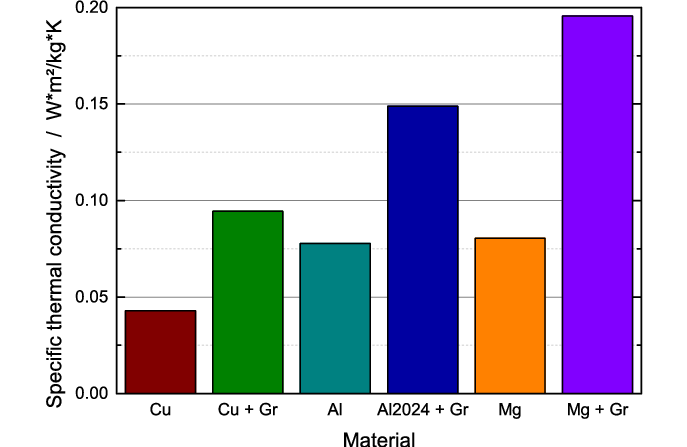
Through the investigation of the importance of the Copper market in the modern world, I explored the idea of alternative materials. Copper represents the worlds most popular choice in the realm of conductivity, both thermal and electrical. Approximately three quarters of copper utilization are accounted for in electrical usages such as power transmission and generation, wiring and telecommunication, and electrical and electronic products. In electrical applications, copper is king, only being outmatched in its conductive prowess by silver (Cu 100% IACS vs Ag 105% AICS), a material which costs on average 100 times more with a lower corrosion resistance resulting in a higher baseline and repair cost. Interestingly enough, however, it is far from the most thermally conductive material. The figure below demonstrates the specific conductivity of various metals and outlines the mediocre performance of Copper:
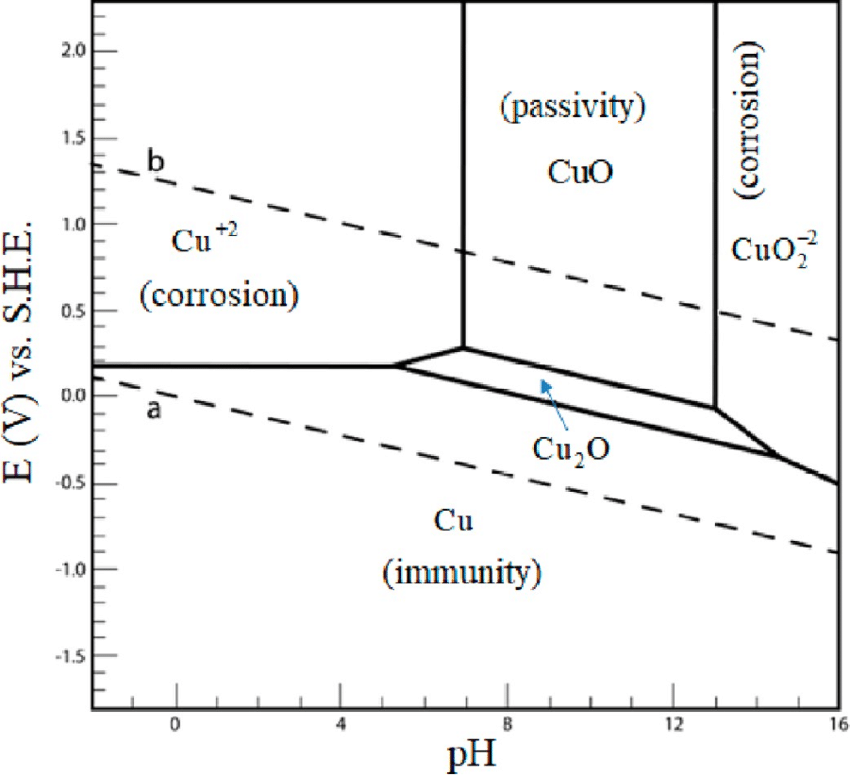
In the energy sector, Copper’s thermal conductivity plays an important role. Almost every kind of electricity generation method involves the heating of gases to spin turbines and produce electricity. These processes come with the requirements of having steam generators, condensers, and heat exchangers, each dependent on Copper for its thermal conductivity to disperse heat. Although not necessarily the most thermally conductive, corrosion resistance and cost make it the choice material for such applications. Below is the Pourbaix diagram of Copper which demonstrates the broad range of potentials and pHs within which the material is immune or passive:
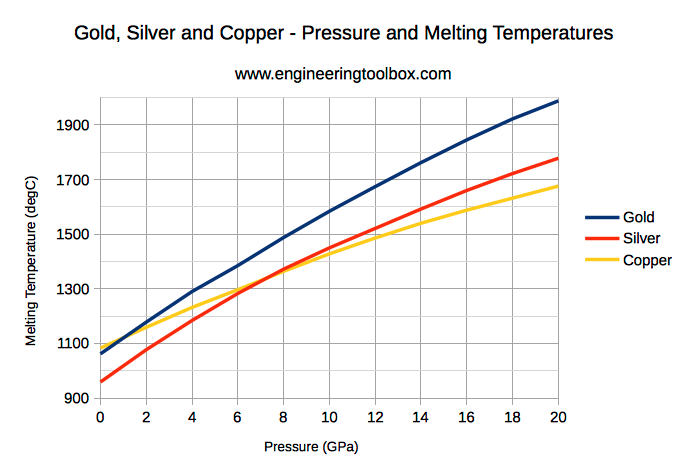
Comparatively, the only materials which possess similar, electrical conductivity, thermal conductivity, and corrosion resistance are Gold, Silver, and Nickel. In initial cost alone, each of the aforementioned materials is substantially more expensive than Copper. On top of initial cost, the recycling cost is far higher as well. Melting points of metals dictate the quantity of energy required to melt and reform the metal. As shown in the figure below, the low melting point of Copper (and subsequent lower energy requirement for recycling) further emphasizes its value as a material:
Financial Implications
Through the analysis of the technological advancements in mining and the state of the copper supply chain, what companies and industries are bound to thrive in the coming years? As copper remains the most cost-effective conductive material despite rising prices, the market performance of mining companies with heavy investments in the material and its acquisition will remain strong. However, companies which decide to make early investments into the implementation of Industry 4.0 technology will reduce their susceptibility to costly failures which impact production, public and governmental opinion, and the safety of employees.
Investments in these technologies will improve market performance of the mining companies who are ahead of the curve on implementation. BHP and Codelco for example are leading the industry in implementation and should continue to exhibit growth while reaping the benefits of more efficient operation and larger production. Despite BHP exhibiting strong quarterly performance marginally ahead of projected production, increasing capital expenditures are impeding future cash flows and negatively impacting the fair market value of the stock. Furthermore, larger diversified miners will have more available capital to make such investments such as Rio Tinto, Freeport-McMoRan, and Teck Resources. A necessary consideration is tariff uncertainty as Copper experiences a more volatile cost variance due to American dependence on international Copper from Australia, Africa, and South America. This dependency has resulted in fluctuations in immediate demand as American consumers stockpile the metal in an attempt to avoid cost surges from tariffs on international goods. This volatility can impact certain mine operators more than others depending on the diversification of their sites. Investments in operators with considerable investments in copper will result in more potential upside from the metal versus a more steady and slow growth for operators with a more diversified portfolio. Outside of mine operators, sensor manufacturers producing proximity, force, LiDAR, temperature, and rpm sensors which are essential to mining operations should see steady and continuous growth due to steady demand. Such companies include industry titans such as Honeywell, Texas Instruments, and Rockwell as well as smaller emerging companies with a specialization in mining such as TE Connectivity. It is important to note that Automation/AI firms which receive large contracts to develop and implement their technologies may also find substantial growth, however, investors need to be cautious about the state of the AI market and its over-evaluation. Many firms are highly evaluated due to the quality of their product and not tangible revenues making their stocks dangerously sensitive to the contracts they receive and to evaluations of similar firms with competitive products. The oversaturation of such AI firms leads to a volatile turnover rate and short company lifespans. These are high risk-reward investments which long term investors should be cautious about but with huge potential upside for short term investors.
BHP Modelling
As part of an iterative valuation process, I constructed three valuation frameworks to evaluate BHP Group (NYSE: BHP). I initially applied a levered free cash flow DCF, which proved inadequate as it overly penalized the company for cyclical commodity revenues while embedding capital structure effects that distorted equity value. To address this, I transitioned to an unlevered free cash flow model, allowing operating performance to be isolated and enterprise value to be estimated without double-counting debt obligations.
Ultimately, recognizing the limitations of applying a single corporate WACC to a diversified mining portfolio, I developed a sum-of-the-parts (SOTP) net asset value (NAV) model. Each major commodity segment was valued independently using asset-specific assumptions for pricing, costs, and discount rates. This approach more accurately captured differences in risk, margins, and cyclicality across commodities while enabling structured upside and downside scenario analysis driven by commodity price sensitivities.
Under a constructive scenario assuming a continued structural supply deficit in copper, with prices stabilizing around $4.2/lb and uninterrupted production at existing operations, the model produces a valuation of $71.53 per share, implying the current market price reflects a 3.54% discount to intrinsic value. Persistent volatility across commodity markets may explain this modest dislocation.
In a downside scenario, assuming softer copper pricing of $4.0/lb alongside declining iron ore prices to $80/t from $84/t over a five-year forecast period, the implied valuation falls to $67.32 per share, representing a 2.56% downside from current levels.
Given BHP’s investments in Industry 4.0 technologies at its copper operations, combined with the asymmetric risk profile in which upside potential meaningfully outweighs downside risk, I recommend BHP as a Buy.